
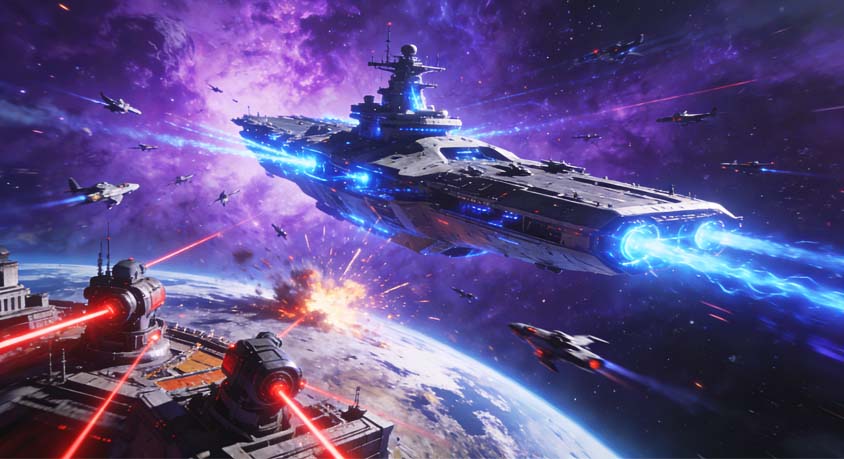
Let me take you back to 1999, a simpler time when the biggest threat to humanity was Y2K and the biggest thrill in gaming was commanding a fleet of spaceships in three dimensions. Homeworld wasn't just a game; it was a revelation. It took the staid, two-dimensional battlefield of traditional RTS games and exploded it into the full, terrifying majesty of space. You weren't just moving units on a flat map; you were orchestrating a ballet of destruction across multiple axes, your frigates drifting above and below the galactic plane, your interceptors swirling in three-dimensional dogfights. It was beautiful, it was brain-meltingly complex, and it was, for a brief, glorious moment, the future of strategy gaming. Then, somewhere along the way, that future faded. The RTS genre, once the king of PC gaming, retreated into the nostalgic margins, replaced by MOBAs and autobattlers and whatever other acronym the kids are into these days. Now, after two decades, Homeworld 3 has arrived, a lovingly crafted sequel from the original creators, and it's a masterpiece. It's also, quietly, a beautiful, lonely monument to a kind of gaming that might no longer have a place in the modern world. The epic has returned, but the audience that once understood its language has scattered to the stars.
The first thing you notice about Homeworld 3 is how utterly, breathtakingly itself it remains. This is not a game that has been simplified, streamlined, or "democratized" for the masses. It is a dense, demanding, deeply rewarding strategy experience that assumes you are willing to learn its language. The tactical depth is staggering. The new "megastructures" that litter the battlefields aren't just set dressing; they're tactical elements, offering cover, ambush points, and new dimensions of positioning. You can hide a carrier behind a wrecked alien ship, then launch a surprise attack from an unexpected angle. You can use the environment to shield your resource collectors while your bombers loop around a ruined structure to strike an enemy capital ship from below. It's chess in three dimensions, played at the speed of light. For a veteran, it's a homecoming. For a newcomer, it's a wall of incomprehensible noise.
And that, right there, is the core tension. Modern gaming, for all its virtues, has trained players to expect a certain kind of experience. We want clear objectives, gentle learning curves, and immediate gratification. We want dopamine hits delivered on a schedule. Homeworld 3 offers none of these things. Its campaign is a slow burn, a methodical journey across a hostile galaxy where a single misclick can cost you a frigate you've nurtured for hours. Its controls, while refined, still require you to think in three dimensions, to manage formations and firing arcs and fuel reserves. It asks for your attention, your patience, and your brainpower in a way that most modern games are almost afraid to demand. It's not gatekeeping; it's just operating on a different frequency, one that many younger players have never learned to tune into.
This creates a fascinating paradox. Homeworld 3 is, by any objective measure, a triumphant return. It honors the legacy, advances the mechanics, and delivers the epic, operatic space opera that fans craved. But its very fidelity to its roots makes it a relic. It's a beautiful, lovingly restored vintage car in an era of electric scooters. Everyone can appreciate its craftsmanship, but fewer and fewer people know how to drive it. The game's audience is, largely, the same people who played the original twenty years ago, now a little greyer, a little slower, but still capable of commanding a fleet. The question the game silently poses is whether a new generation will arrive to take their place.
So, does Homeworld 3 signal a renaissance for hardcore RTS? Probably not. It's more like a final, glorious flare from a dying star, a reminder of what the genre was capable of at its peak. It's a game for the faithful, a gift for those who never stopped believing that space combat should be complex, beautiful, and demanding. And maybe that's enough. Maybe not every game needs to be for everyone. Maybe there's still room, in this vast, crowded marketplace, for a game that looks at you and says, "This will be hard. You will fail. But if you learn, you will experience something no other medium can provide." Homeworld 3 is that game.